
Unleash your Inner Scientist™
Haven’t you always wanted to “do some science” with your telescope or standalone DSLR?
The science is easy and exciting. You can learn as you go with our tutorial videos.
With just a small telescope you can easily:
- determine any star’s OBAFGKM star-type and temperature from its spectra curve.
- identify the composition of a star or nebula from its emission and absorption lines
- detect the cosmological red-shift of a distant quasar!
- measure the blue-shift of a supernova’s expanding shell as it races towards us at millions of miles/hour.
Sky and Telescope Interview
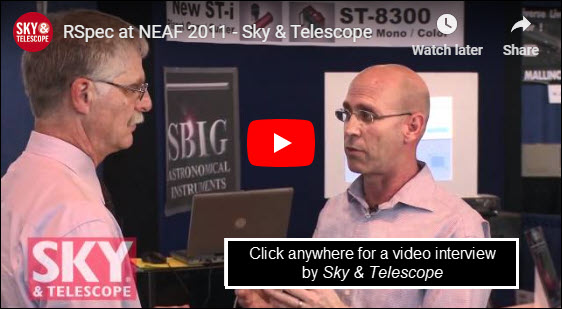
In the video below, Dennis di Cicco, Senior Editor of Sky & Telescope Magazine interviews the author of RSpec, Tom Field.
Hear how easy it is to get started and the wonderful results you can get with a DSLR or a small backyard telescope. Dark skies and big telescopes aren’t necessary! You can probably get great spectra with your current setup, even from the suburbs. Watch this video:
The short video below will explain a bit more about spectroscopy with a small telescope, how exciting it is, and how you can probably use your current equipment.
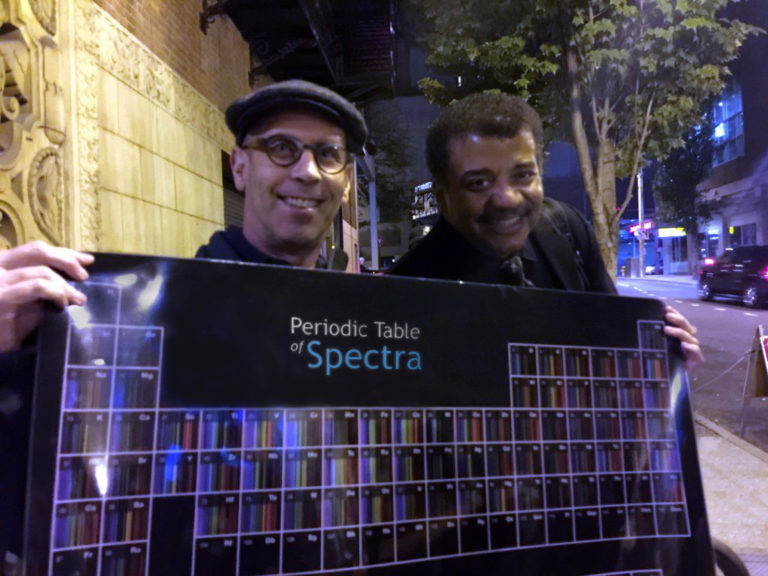
Periodic Table of Spectra
Looking for our new poster? Click on this link.
Pardon our smile!

We’re pleased that Sky & Telescope Magazine awarded our RSpec software their “Hot Product” award. The award is given for product excellence and technical leadership. Our customers tell us the award was well-deserved because our ground-breaking software allows you to easily capture and process the spectra of stars.
Now you can easily capture the spectra of stars
Our RSpec software enables you to rapidly go from a static image (FITS, JPG, etc. or DSLR) or video file to a calibrated spectrum graph – in real-time. Now you can see a star or planet’s spectrum graph instantly, right at your telescope! No more waiting until later to see if you got the spectrum you hoped for.
Getting started in spectroscopy is easy. Use our inexpensive Star Analyser grating (link) on almost any camera or telescope. You’ll be able to easily see the spectra of distant stars. You can even use a DSLR camera — no telescope needed.
But, don’t take our word for it — the video below shows the spectra of a bright star taken at 5 frames/second using an inexpensive video camera!
Better yet, see for yourself what’s possible. Check out our sample results page that shows what amateurs just like you have done: link.
In the past, creating an intensity graph from a star’s spectrum was a painful trial-and-error process. But, now, because RSpec displays your profile graph immediately, it’s painless.
No one likes the drudgery of complicated image processing and steep learning curves. Astronomy is supposed to be fun! With RSpec, you can go from your original image to a calibrated profile graph in just a few clicks. See a star’s spectrum in real-time at your telescope!
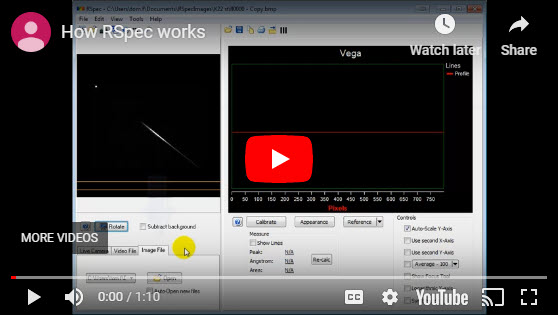
Click the image below to watch a one-minute video that shows RSpec in action:
Want to see what else you can do in spectroscopy? Check out our Sample Project page: link.